Antibiotic susceptibility, interpreted the way CLSI actually specifies it.
CLSI AST Reporter is a Windows application built for microbiology labs and prescribing physicians. Enter zone diameters or MIC values, and the clinical engine applies CLSI M100 breakpoints and expert rules — with the reasoning shown, not hidden.
30-day full trial · No credit card · Single .exe installer
Manual CLSI interpretation is where good microbiology quietly goes wrong.
Breakpoint tables change edition to edition, exceptions apply only to certain sample sources, and inferred results depend on rules most lab software treats as an afterthought. CLSI AST Reporter treats the interpretation itself — not just the report layout — as the product.
Interface never calculates
The screen you see and the engine that interprets results are cleanly separated. Every classification comes from the clinical knowledge base, not from UI logic — so what you see is what CLSI says.
Fail-closed by design
Ambiguous cases are labelled "unknown" rather than guessed. Drug-to-drug inference is applied only where CLSI explicitly supports it — for example, inferring tetracycline susceptibility, never the reverse.
A decision aid, not a verdict
Every report carries its rationale and a clear reminder: CLSI AST Reporter supports clinical judgment — it does not replace the microbiologist or prescriber.
From raw zone diameters to a finished report in four steps.
Enter results
Record the organism, specimen source and each antibiotic's zone diameter or MIC value.
Engine interprets
The clinical engine applies the matching CLSI M100 breakpoints, species exclusions and phenotypic conditions.
Expert rules apply
Unusual phenotypes, sample-source restrictions and drug-to-drug inferences are checked automatically, with the reasoning attached.
Report & archive
The finished report is reviewed, printed or exported, and the encrypted patient record is saved with a full audit trail.
A report a physician can act on without calling the lab.
Every flagged result — resistant, inferred, or requiring mechanism verification — is annotated in plain language, with the CLSI table and comment it came from.
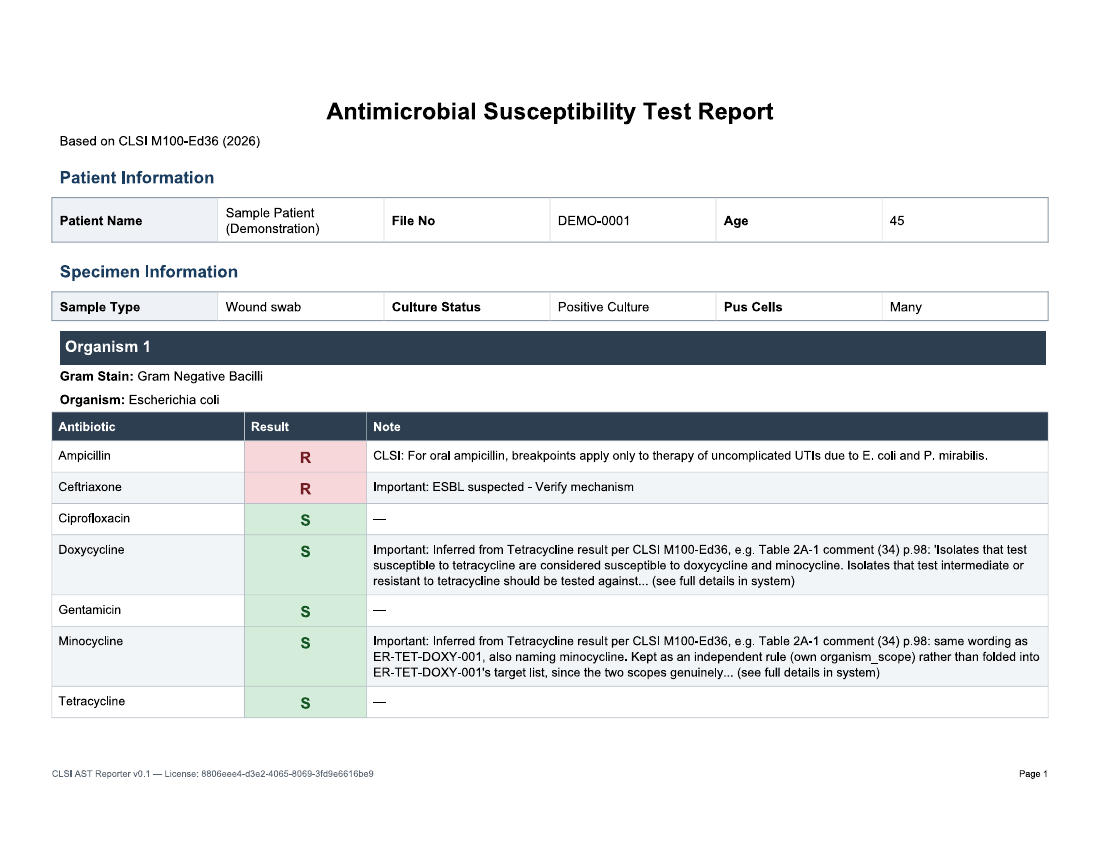
Sample output, demonstration data. Patient names are encrypted at rest; only the file number is stored in plaintext for search.
Built for the lab bench, and for the patient records behind it.
Clinical knowledge base
439 breakpoint rows and 12 organism mappings, rebuildable independently of the application, so a CLSI edition update never means reinstalling the program.
Advanced interpretation logic
Sample-source restrictions, phenotypic conditions and species exclusions are handled explicitly — urine-specific breakpoints and unusual phenotype detection included.
Verification-first data changes
Every change to the clinical data requires PDF verification against the source standard and formal review before it reaches the knowledge base.
Encrypted patient records
Patient names are encrypted (Fernet/AES); only file numbers stay in plaintext for search. Records live in a separate database, stored outside the program folder.
Full audit trail
Every create, update and delete on a patient record is logged, with backup and restore built in — not bolted on.
Simple to deploy
A single .exe via PyInstaller, a professional Inno Setup installer, and a 30-day trial with hardware-fingerprint and clock-tamper detection.
Clinical scope
Try it free for 30 days on your own workstation.
The trial installs like the licensed version — same knowledge base, same engine. Contact us for a download link and licensing for your lab or department.
Single-machine installer
30-day trial license
Hardware-locked activation
Offline after activation
Talk to the team behind CLSI AST Reporter.
Reach us directly on WhatsApp, by email, or send a message with the form and we'll get back to you.
Dr. Husam Hassan
Dr. Abdalla Ahmed
Or write to us at info@noorbiotech.com